What OpenAI's enterprise AI report actually found
The rest of what's in the report behind the reel, the parts that didn't fit in 60 seconds.
Here’s the rest of what’s in the report behind the reel, the parts that didn’t fit in 60 seconds.
The real shift: from answering questions to finishing tasks
The report’s central finding is a shift in how companies use AI. Early adoption was mostly people asking AI questions and reading the answers themselves. What’s changing now is companies letting AI agents actually finish tasks end to end, not just advise on them.
One sign of how far that’s gone: as of June, a tool built for agentic, multi-step work (Codex) generated 64% of all enterprise output, more than the assistant-style tool it’s paired with. That’s a real swing toward AI doing the task, not just answering the question.
The gap between AI-forward companies and everyone else is widening fast
OpenAI splits its enterprise customers into two tiers based on how much they use AI each month:
- Frontier firms — the top 10% of usage. OpenAI’s own label for its most active customers, regular companies across every industry, not AI research labs like OpenAI or Anthropic themselves.
- Typical firms — companies in the 45th to 55th percentile, the real middle of the pack.
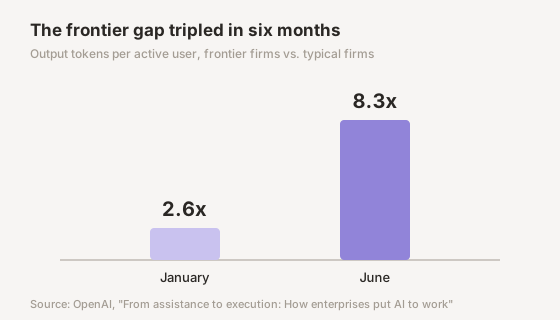
Frontier firms now generate 8.3 times more output per active user than typical firms, up from 2.6 times just six months earlier. That gap roughly tripled in half a year, and it isn’t from frontier firms simply sending more messages. Message volume only explains about a third of the difference (36%). Most of the gap comes from how they use AI, deeper, more complete work with each interaction.
Adoption spread far beyond engineering
Non-developer use of the agentic tool grew 137 times over since last August. This technology moved well past a narrow technical group.
That spread wasn’t even across departments. Here’s the growth in weekly active agent users by business function since February:
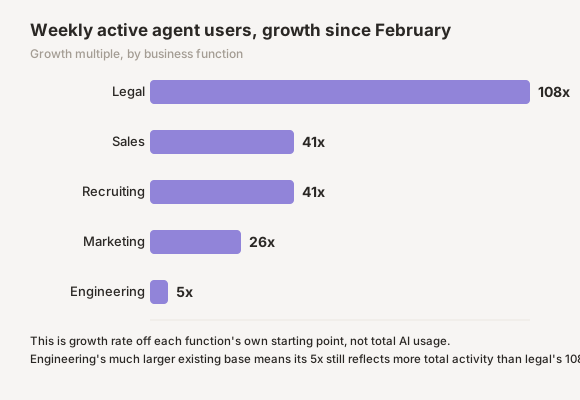
Legal’s number is the most dramatic, and it’s worth being precise about what it means. This is growth rate, not total volume. Legal started from a very small base of agent use, mostly around contract review and compliance document work, so even a modest jump in adoption produces a huge multiple. Engineering’s 5x looks small next to that, but engineering’s starting point was already high, so that 5x still represents more total activity than legal’s 108x. Read this chart as which departments are catching up fastest, not which department uses AI the most.
The actual mechanism: apps plus skills
What lets a company move from AI answering questions to AI finishing tasks is something the report calls a plug-in, built from two separate pieces:
- Apps — the connection between AI and your company’s actual data and tools (email, shared drives, project systems, and so on).
- Skills — reusable instructions for what to actually do once it has that access.
Apps alone get AI in the door. It can see your data, but someone still has to tell it what to do with it, every single time. Skills are what let it act on that access and finish something on its own. That’s the difference between a chatbot you have to walk through every step and an agent you can actually hand a task to.
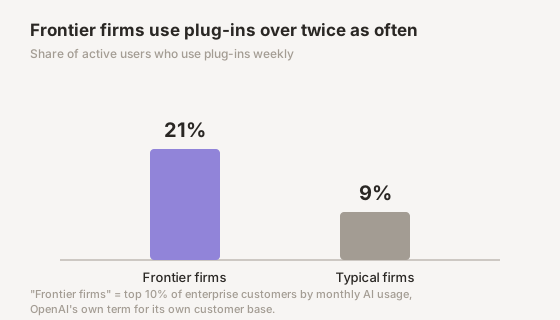
That gap tracks directly with the productivity numbers above: 21% of active users at frontier firms use plug-ins every week, compared with 9% at typical firms. The companies pulling ahead are building both halves of the same tool instead of stopping at the first one.
What the report recommends doing about it
OpenAI’s own practical guidance, condensed to three pieces:
- Connect agents to the actual context and tools they need. Access is step one, not the whole plan.
- Set clear permissions and human review. Most of this is managed at the company admin level.
- Turn one person’s good AI workflow into a shared team habit. The biggest gains come from spreading what already works for one person to the rest of the team, not from any single tool purchase.
That’s the whole report boiled down: the technology moved from answering to doing, the gap between companies who noticed and companies who haven’t is real and growing, and the mechanism behind it is two ordinary things, access and instructions, most people only ever build one of.
Source: OpenAI, “From assistance to execution: How enterprises put AI to work,” https://openai.com/index/how-enterprises-put-ai-to-work/